
From Janka hardness to wood rays, from the three cuts to yield — a long read that explains the fundamentals of wood, worth finishing before you choose materials.
Janka hardness is the internationally common measure of wood hardness: a steel ball 11.28 mm in diameter is pressed into the wood until it sinks to half its height, and the load applied is the hardness value. Harder woods are more stable and suited to openwork carving, and finished pieces are durable and long-lasting, but they cost more; softer woods are more affordable.
A crown-cut (flat-sawn) face is produced by sawing and planing at roughly 45 degrees to the trunk and is best for observing grain effect; a cross-section is perpendicular to the trunk and clearly shows growth rings and pith structure; a quarter-sawn face reveals wood rays as ribbon-like forms. From one log, different cutting methods produce completely different grain expressions — which is exactly the pleasure of selecting veneer.
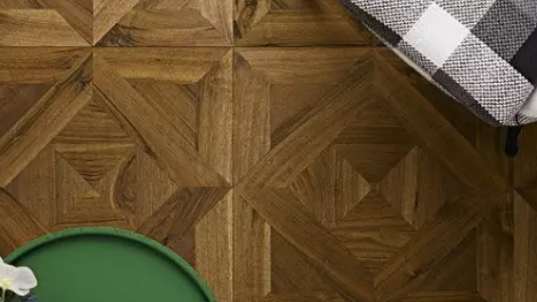
On a cross-section, wood rays radiate like fine lines; on a quarter-sawn face they appear as broken or continuous ribbons, often with a distinctive silver sheen. By width they are classified as uniseriate, biseriate, multiseriate, aggregate and oak rays. Made of thin-walled cells, wood rays are among the weaker parts of wood’s physical and mechanical properties — timber often cracks along them during drying — but their quarter-sawn face adds unique decorative value.
Grain is formed by the orientation of the wood’s main cells and includes straight, interlocked, spiral and wavy types; wavy grain makes the surface uneven and harder to machine. Yield measures the ratio of output to harvested volume and directly affects production economics — raising yield depends both on equipment and process and on a deep understanding of each timber’s temperament.

Talk to us about custom veneers and genuine wood interior solutions.